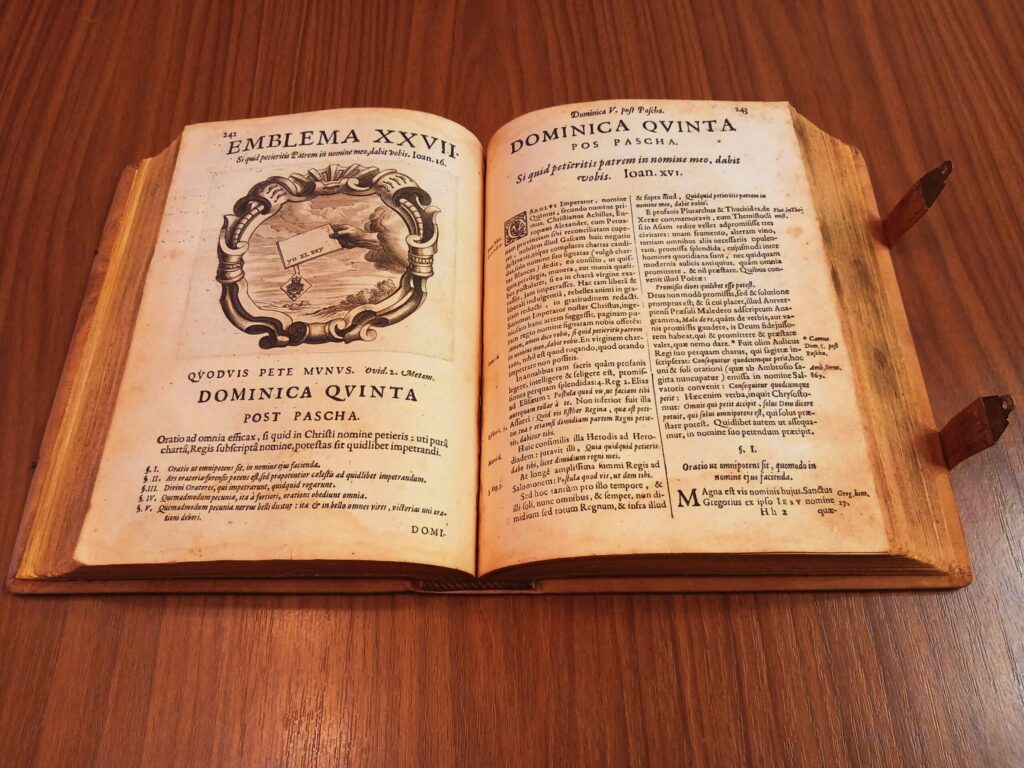
Heinrich Engelgrave: Lux evangelica sub velum sacrorum emblematum recondita. Antwerp, 1651, 2nd edition. In parchment knitting, with blind-print decoration, staples. The volume can be found under the sign C 4920 of the József Lévay Museum Library. The book lasts for a month. You can see it in the gallery of Ferenc Rákóczi Library on the ground floor.
A Lux Evangelica the King's Emblem
In the present times, where man clashes with images at every turn, and not infrequently with those which are more intrusive than their meaning justifies, there is a peculiar calmness in a conception which, in imagery, seeks not the greedy stimulation of the eye, but the silence of the mind. It is as if the picture were not here to shine for itself, not to triumph over some quick and superficial impression, but to be a veil that hides and reveals at the same time.
the Heinrich Engelgrave Lux evangelica (The Light of the Gospel) In recommending his first edition, he compares his work to the ancient obelisk: As the sides of the obelisk were adorned with various reliefs, not only for the pleasure of the eye, but also for instruction and profit, so the emblems of the ? show heavenly wisdom under the veil of images. The image here is a means of gathering attention; It is not a spectacle, but a disciplined mediation. This attitude, which puts the sensible at the service of consciousness, may now seem more alien than ever, and therefore more worthy of our gaze.
Heinrich Engelgrave (1610-1670) was a prominent Jesuit orator of the Netherlands, whose name is now less widely known than it is in his life and for generations to come. From 1648 his works appeared in Antwerp, Cologne and Amsterdam, and for a long time they exerted considerable influence. His work consisted of more than two hundred and fifty sermons; These were richly inspired by profane and ecclesiastical historical examples, showing not only his memory, but also his broad and living culture.
A Lux evangelica The first edition of the sermon collection was published in Antwerp in 1648 by Jan Cnobbaert's widow and heirs. The Cnobbaert family of printers was in close contact with the Jesuits and published a number of ecclesiastical works; Engelgrave's work fit into this environment with natural security. Its success was quick and tangible: In 1651 an extended second edition (this volume) was published, and within a short time the second part was published. All this suggests that what we are dealing with here is not simply a pious book of the time, but something that united the religious imagination and educational intent of the age. Behind the popularity of such works is usually not a single virtue, but a rare encounter of several qualities: oratory, education, a sense of form, and the ability to present the abstract doctrine to the reader in a form that can be grasped.
On the twenty-seventh emblem of the volume, a hand protruding from a cloud holds a signed but empty letter. The page reads in Spanish: YO EL REY, i.e. I, the King. The blank, but already signed page expresses, in almost mathematical conciseness, that the content of the application has not yet been completed, but has already been pre-approved by the highest authority. Ovid's motto ? Quodvis pete munus, i.e. Ask for whatever you want ? It is also the equivalent of this poetry and emblem tool. The entire composition thus brings together the proposition that prayer in the name of Christ is a petition submitted with royal authority.
Engelgrave's secular parallel illustrates the same idea with a living historical example in the text of the sermon: Emperor Charles V (ruler: 1519-1556), after wishing to appease the province of Peru, the notable Pedro de la Gasca was assigned to this task, and he gave him certificates of full power, bearing only his own signature, the so-called White letters? (cartas blancas). His intention was that if anyone demanded privileges, gifts, or any kind of privileges, Gasca would be able to hand them over with imperial confirmation by writing them in an empty letter. To this extraordinarily free and generous indulgence the rebellious spirits responded with gratitude. The beauty of this example is that it is both political and spiritual. Here the pre-signed card of grace of the earthly ruler will be a symbol that the highest power is not only ready to listen, but also opens the way of petition.
So we get back to the initial thought: The picture, if it is really deep, does not close, but opens the contemplation.
Szuhai Milán
librarian
József Lévay Museum Library
Literature
Marc Van Vaeck: The Use of the Emblem as a Rhetorical Device in Engelgrave?s emblematic sermon books, In: Emblemata Sacra. Rhetorique et herméneutique du discours sacré dans la littérature en images = The Rhetoric and Hermeneutics of Illustrated Sacred Discourse, ed. Ralph Dekoninck ? Agnès Guiderdoni-Bruslé. Turnhout, 2007.