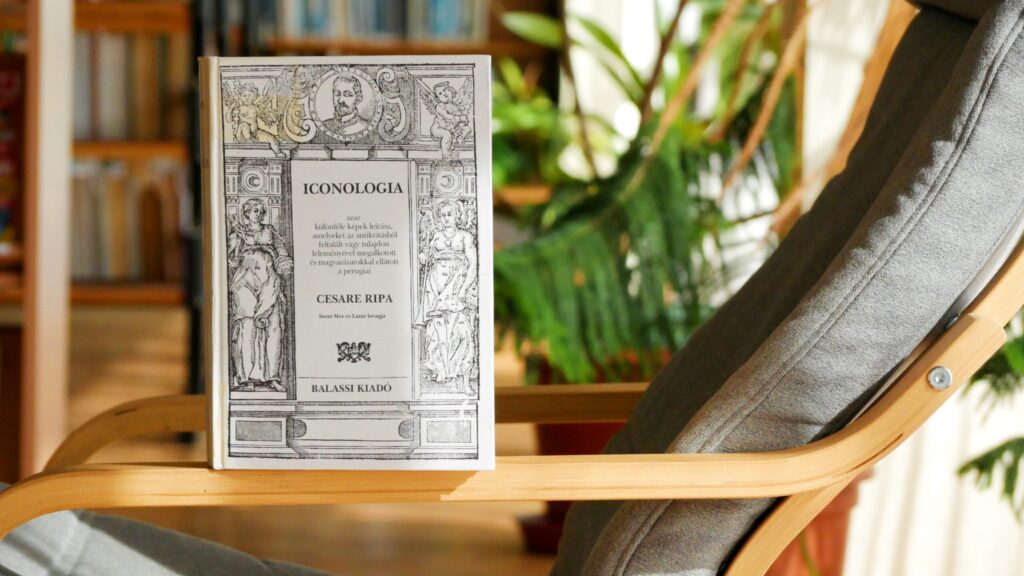
This article by Cesare Ripa Iconologia The title describes his work in a nutshell.
Full title of the book: Iconologia, that is, the description of various pictures invented from antiquity or created by his own invention and explained by the Cesare Ripa of Perugia, the Knight of St. Mor and Lazarus. The book is an iconic Symbol Dictionary, the most influential work of the Baroque era.
The first edition was published in 1593. Vincenzo Cartari Pictures of Ancient Gods Like the book (1556), it was not originally illustrated. However, all Italian and European painters and sculptors soon began to use it in their workshops. Many 17th century artists and painters refer to it as a handbook, Ovid Transformations Together with his work, he is regarded as the painter's bible. The volume interprets the visual representation of abstract concepts. It contains pictures from antiquity and the author's own creations, with explanations. Ripa's work was a fundamental resource for artists and scientists, providing guidance on how to portray complex ideas and making a huge impact, from frescoes to sculptures, all the way to St. Petersburg and Mexico. It has more than 40 editions in seven different languages. Indirectly or directly, it inspired thousands of frescoes and board paintings.
The Hungarian edition is the work of Tamás Sajó, published by Balassi Publishing House in 1997. The translation was based on the second edition of 1603, which was extended by Cesare Ripa with about 400 images compared to the first edition, and was decorated with woodcut illustrations for the first time. These woodcuts can also be found in the Hungarian edition. In addition, the Hungarian edition is significant because ?, before all other language versions, is the first annotated edition, as the author supported his work with a huge amount of contemporary and classical quotations.
About the author
Cesare Ripa was born into a poor Perugian family around 1555. The exact date of his birth was never determined. He was very active in intellectual circles as a member of the Siena Filomati and the Intronati Society. The members of both societies devoted their lives to the study of antiquity and Greek and Latin literature. He was also a member of the Insensati Society in his native town.
At a young age, he went to Rome, where he worked for Cardinal Antonio Maria Salviati. He was a student at Academia Santa Lucia. It was probably here that he met the mathematician and Dominican monk Ignazio Danti and was introduced to the cultured social circles of Baroque Rome. Among his friends he counted, among others, Pietro Leone Castella (1540 c.-1620 c.), whose Elogia illustrium artificium The title was published in 1606. Castella and Prospero Podianira (1535-1615) Iconologia It is also mentioned in Ripa's work.
Ripa Iconologia The title became a huge success. The first edition of 1593 was followed by countless others and translated into many languages. He maintained a close friendship with the famous artists of the time. Among others, the Alberti brothers Giovanni, Alberto, and Cherubino, who used the first edition of the book in 1593 to decorate the Vatican's Sala Clementina (1595-1602).
Ripa in 1598 VIII. Pope Clement made him a knight of the Order of St. Mor and St. Lazarus. He died in Rome on 22 January 1622.
The only known cause is the Iconologia. The exquisitely exhibited volume, decorated with black and white illustrations, can be found in the József Lévay Museum Library as well?.
Rónai Mónika
Director of Libraries
József Lévay Museum Library